3D printing can release particles, odors, and volatile organic compounds, especially when working with resin, ABS, ASA, or other materials. The right air purifier can help reduce airborne contaminants and make a hobby workspace more comfortable.
We selected 10 air-cleaning options for different printer setups, from compact activated-carbon units for resin printers to HEPA H13 filtration systems designed for enclosed machines.
Best 10 3d Printer Air Purifiers for Hobbyists Picks for 2026
Compact Resin Odor Pick
ELEGOO Mini Air Purifier 2-Pack

- Two rechargeable activated-carbon purifiers
- At least 24 hours of operation per charge
- Quiet 10dB design for resin setups
Best For: Hobbyists needing compact odor control for LCD, DLP, or MSLA resin printers
Enclosed-Printer Filtration Pick
HEPA H13 Carbon System for Bambu Lab

- Pre-filter, HEPA H13, and carbon stages
- Airflow up to 60 m³/h
- Quick-swap filter modules
Best For: Bambu Lab P1S and X1C users printing PLA, PETG, ABS, ASA, or Nylon
Large Resin-Workspace Pick
- Claims removal of up to 95% TVOC
- Built-in VOC sensor and filter reminder
- 35dB operation with 6W power use
Best For: Compatible resin-printer setups with room for a larger dedicated purifier
Material-Focused FDM Pick
Triple-Layer Printer Filtration System

- HEPA H13 plus activated-carbon filtration
- Targets PLA, PETG, ABS, ASA, Nylon, PA, and TPU
- External design with quick-swap filters
Best For: Enclosed-printer users working with varied FDM filaments
Powerful Resin Filtration

- HEPA plus 4.4 lb activated carbon filtration
- Adjustable brushless-fan speed control
- Includes hose, fittings, and power supply
Best For: Resin-printing hobbyists with compatible ELEGOO or ANYCUBIC printers
Compact Resin Odor Control
- Tiny 4.5-inch-wide desktop design
- High-density replaceable activated carbon
- Two purifiers included with quiet fans
Best For: ANYCUBIC resin users focused on compact odor control
Best Compact Laser-and-Printer Extractor

- H13 HEPA and carbon filtration
- Compact desktop footprint
- Three-speed control and status alarm
Best For: Hobbyists combining enclosed 3D printing with compatible desktop laser work
Best Dedicated Enclosed-Printer Filter
- Three-stage HEPA and carbon filtration
- Supports common PLA, PETG, ABS, ASA, and nylon
- Up to 60 m³/h airflow
Best For: Enclosed-printer hobbyists seeking broad filament compatibility
Best High-Capacity Smart Purifier

- Five-stage filtration with dense carbon
- 250 m³/h airflow and 1700 Pa suction
- Touchscreen PM2.5 and filter monitoring
Best For: Frequent FDM printing in a dedicated workshop
Compact Resin Odor Pick – ELEGOO Mini Air Purifier 2-Pack
For hobbyists seeking 3d printer air purifiers for hobbyists, this two-pack is a compact option for resin-printing setups. Each rechargeable unit uses activated carbon to target resin odor and can run for at least 24 hours after charging.
Best For: Resin printer users who want small, rechargeable odor-control units for LCD, DLP, or MSLA printers.
Pros:
- Activated-carbon filtration targets irritating resin odors.
- Two units can suit multiple printers or provide flexible placement.
- Rechargeable 2,000mAh battery supports at least 24 hours of continuous operation.
- Quiet 10dB operation and compact 4.21-inch height suit small workspaces.
Cons:
- Designed for resin odor control rather than broad particle filtration.
- Carbon blocks generally need replacement every three to six months.
- Replacement carbon must be purchased separately.
This is a straightforward choice when portability, low noise, and odor reduction matter more than a larger multi-stage filtration system.
Enclosed-Printer Filtration Pick – HEPA H13 Carbon System for Bambu Lab
Among 3d printer air purifiers for hobbyists, this system stands out for enclosed FDM printers that need more than odor control. Its pre-filter, HEPA H13 layer, and chemically activated carbon bed are designed to address particles and fumes from materials such as PLA, PETG, ABS, ASA, and Nylon.
Best For: Bambu Lab P1S and X1C owners, with adapter-based compatibility for other enclosed printer ecosystems.
Pros:
- Triple-layer design combines pre-filtration, True HEPA H13, and activated carbon.
- HEPA H13 is rated to capture more than 99.97% of ultrafine particles down to 0.3 micrometers.
- Centrifugal fan provides airflow up to 60 m³/h while supporting stable enclosure conditions.
- Tool-free, quick-swap filter modules simplify maintenance.
Cons:
- Default connector is intended for Bambu Lab P1S and X1C; other printers may require adapters.
- At 3.54 pounds, it is less portable than small plug-in or rechargeable purifiers.
For hobbyists printing engineering materials in an enclosed machine, this is the more comprehensive filtration approach, provided the connector setup matches the printer.
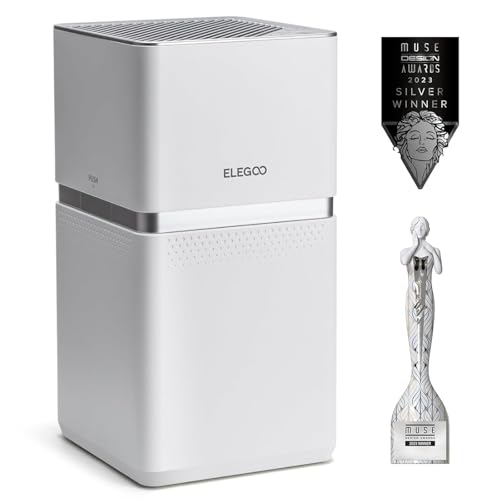
Large Resin-Workspace Pick – ELEGOO MARSMATE Air Purifier
For resin users comparing 3d printer air purifiers for hobbyists, the ELEGOO MARSMATE offers a larger plug-in design with activated-carbon filtration. It is built for compatible photocuring printers and includes a VOC sensor that can alert users when the filter needs attention.
Best For: Resin-printing hobbyists with compatible ELEGOO or other printers featuring an extension port.
Pros:
- Designed to remove up to 95% TVOC according to the supplied product claim.
- VOC sensor provides a reminder to replace the filter element.
- Automatic low- and high-speed modes help keep operating noise to 35dB.
- Compatible with a broad list of ELEGOO resin printers, including Mars and Saturn models.
Cons:
- Its large 16.14-inch height requires substantial workspace.
- Built-in activated-carbon filters are listed for up to two months of use.
- Compatibility depends on having a suitable extension port.
This model makes the most sense when you have room for a dedicated purifier and value VOC monitoring alongside resin odor control.
Material-Focused FDM Pick – Triple-Layer Printer Filtration System
This filtration system is a strong contender for hobbyists looking for 3d printer air purifiers for hobbyists that address both particles and material-specific emissions. Its three-stage design targets common FDM materials, including PLA, PETG, ABS, ASA, Nylon, PA, and TPU.
Best For: Owners of enclosed P1S or X1C-style printers who want external, serviceable filtration for varied filament use.
Pros:
- Pre-filter, HEPA H13, and activated-carbon stages provide multi-layer filtration.
- HEPA H13 is rated to capture more than 99.97% of ultrafine particles down to 0.3 micrometers.
- Carbon filtration is formulated for emissions associated with ABS/ASA and Nylon.
- Quick-swap filter modules and an external form factor support convenient maintenance.
Cons:
- Primarily designed for P1S/X1C enclosures; other printers may require printed connectors.
- The supplied notes do not specify operating noise or filter replacement intervals.
Choose this system if broad filament coverage and replaceable multi-stage filtration are priorities, while confirming that an appropriate connector is available for your enclosure.
Powerful Resin Filtration – BD-60E Air Purifier
For hobbyists comparing 3d printer air purifiers for hobbyists, the BD-60E is a purpose-built option for resin printers that combines HEPA and activated-carbon filtration with an adjustable exhaust fan. Its included hose and connectors make it especially practical for supported ELEGOO and ANYCUBIC models.
Best For: Resin-printing hobbyists who want strong, adjustable extraction for compatible enclosed printers.
Pros:
- Combines HEPA filtration for fine particles with 4.4 pounds of activated carbon for gaseous pollutants and odors.
- Stepless speed control lets users balance airflow and noise; the listed noise level is 55 dB.
- Includes a smoke pipe, fittings, power supply, and a large replacement-ready filter.
- Supports a broad list of ELEGOO and ANYCUBIC resin-printer models.
Cons:
- Compatibility with other printer models may require a 3D-printed exhaust adapter.
- At 10.6 pounds, it is less portable than compact desktop purifiers.
- The manufacturer lists a 200-square-foot floor-area rating, but room ventilation is still important.
The BD-60E stands out when filtration capacity and direct printer exhaust control matter more than minimal size. Check the compatibility list carefully before buying, particularly if your printer is not an ELEGOO or ANYCUBIC model.
Enclosed-Printer Specialist – HEPA H13 Filter System
This filter system is a strong candidate for hobbyists seeking 3d printer air purifiers for hobbyists for enclosed FDM printers. Its three-stage design combines a pre-filter, HEPA H13 filtration, and activated carbon, while the centrifugal fan is designed to maintain airflow through the filter stack.
Best For: Owners of enclosed Bambu Lab, Creality, Prusa, Elegoo, or Anycubic setups who want a compact, replaceable-filter system.
Pros:
- Three-stage filtration targets dust, ultrafine particles, VOCs, and chemical odors.
- Default connector supports Bambu Lab P1S and X1C; printable adapters expand compatibility.
- Quick-swap filter modules allow replacement without tools.
- Compact 3.56-pound design can sit beside or inside a printer enclosure.
Cons:
- It is not recommended for open-frame printers without an enclosure.
- Other printer models may require a printable adapter rather than a direct connection.
- The notes emphasize that it reduces emissions but does not replace room ventilation.
This is the most versatile choice of the three for enclosed filament printers, especially if you appreciate easy filter changes and adapter-based compatibility. Continue ventilating the room when printing ABS, ASA, or Nylon.
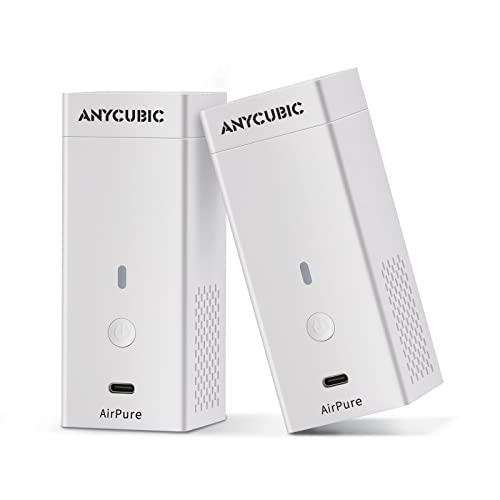
Compact Resin Odor Control – ANYCUBIC Purifier+ Two-Pack
For small resin-printing workspaces, the ANYCUBIC Purifier+ offers a simple, compact approach to 3d printer air purifiers for hobbyists. This two-pack uses replaceable high-density activated-carbon filters and quiet fans to help absorb resin odors around LCD and DLP printers.
Best For: ANYCUBIC resin-printer users who prioritize compact size, low noise, and having two purifiers available.
Pros:
- Very small 4.5-by-1.8-by-1.8-inch body fits easily on or beside a printer.
- High-density activated carbon is designed to absorb resin odors.
- Listed operating noise is up to 40 dB in the product description, supporting quieter printing.
- Two units are included, and each filter is designed for roughly three to six months of use.
Cons:
- Activated carbon is the listed filtration type, so it is less comprehensive than a HEPA-plus-carbon system.
- The compact design is intended for small areas, with a listed coverage of 10 square meters.
- Battery power and touch-control details may be less convenient than a mains-powered purifier for some setups.
The Purifier+ is a convenient low-profile option for resin odor control, particularly when you want one unit per printer or a spare. Choose a larger HEPA-and-carbon system if particulate filtration and ducted extraction are higher priorities.
Best Compact Laser-and-Printer Extractor – NT-X1 Desktop Fume Extractor
If you want a compact option among 3d printer air purifiers for hobbyists, the NT-X1 is designed for enclosed 3D printer setups as well as light-duty laser work. Its H13 HEPA and activated-carbon filtration targets airborne particles, smoke, and odors, while the 60W motor provides steady airflow.
Best For: Hobbyists who use an enclosed 3D printer and also want one extractor for compatible desktop laser projects.
Pros:
- H13 HEPA and activated-carbon filtration is rated to capture 99.97% of airborne particles and reduce odors.
- Compact 6.9 x 9.84 x 7.87-inch design suits a desktop workspace.
- Three-speed control, a built-in status alarm, and approximately 55dB operation add convenience.
- Separate filter sets can make replacement costs more manageable than all-in-one filters.
Cons:
- Its stated compatibility is focused on enclosed printers and light-duty laser equipment, not every printer setup.
- Filter replacement is an ongoing maintenance cost.
The NT-X1 is a flexible, space-conscious choice when your hobby setup includes both 3D printing and laser engraving. For printer-only use, its extra laser-oriented capability may be more than you need.
Best Dedicated Enclosed-Printer Filter – Mintion V1 Air Purifier
The Mintion V1 is a dedicated choice among 3d printer air purifiers for hobbyists who print with materials such as PLA, PETG, ABS, ASA, and nylon. Its three-stage system combines a pre-filter, H13 HEPA filter, and activated carbon filter to address particles, vapors, and odors from enclosed printers.
Best For: Hobbyists using enclosed printers who want broad filament compatibility and a compact, tool-free installation approach.
Pros:
- Three-stage filtration targets dust, ultrafine particles, and VOCs including styrene and caprolactam.
- Up to 60 m³/h airflow is designed to provide purification while maintaining pressure stability.
- Factory-configured for P1S/X1C, with optional printed adapters for several other printer brands.
- Accessible filters and included power adapter, tools, screws, sealing cap, and instructions simplify setup and maintenance.
Cons:
- Compatibility with some printers may require an optional printed adapter.
- The supplied details do not specify filter-replacement intervals or a particle-removal percentage.
With a manageable 3.63-pound weight and a purpose-built design, the V1 is a practical printer-focused system. Confirm your printer’s adapter requirements before buying, especially if it is not a P1S or X1C.
Best High-Capacity Smart Purifier – Creality FDM Air Purifier
For hobbyists seeking 3d printer air purifiers for hobbyists with stronger airflow and monitoring features, this Creality model is built specifically for FDM printing. It combines five-stage filtration, dense activated carbon, 360-degree airflow, and touchscreen controls for tracking PM2.5 levels and filter status.
Best For: FDM users who want high airflow, smart touch controls, and extended stated filter life for a larger or frequently used workspace.
Pros:
- Five-stage filtration includes a G4 pre-filter and high-density activated carbon for dust, particles, and PLA/ABS odors.
- Delivers up to 250 m³/h clean-air flow and 1700 Pa suction according to the supplied specifications.
- Touchscreen shows real-time PM2.5 readings and filter status.
- Stated filter life reaches up to 1,000 hours with the standard filter or 1,500 hours with the V-IFold carbon filter.
Cons:
- At 34.4 pounds, it is substantially heavier than the other options here.
- Its feature set and larger form may be excessive for occasional, small-scale printing.
- The supplied notes say it is intended for most FDM printers, so other printer types may not be covered.
The Creality stands out when airflow capacity, monitoring, and long filter intervals matter more than portability. Its weight and larger package make it better suited to a dedicated workshop than a compact hobby desk.
How We Picked These 3d Printer Air Purifiers for Hobbyists
We focused on filtration design, printer compatibility, footprint, noise, replacement-filter considerations, and the types of emissions each unit is intended to address. Activated carbon is important for odors and many vapors, while HEPA filtration is designed to capture fine airborne particles. Products marketed for enclosed printers, resin machines, or laser and printer enclosures were evaluated according to their stated use cases.
Claims such as removal percentage and filtration efficiency are manufacturer specifications, not a guarantee of total exposure protection. Good ventilation, printer enclosures, safe material handling, and appropriate personal protective equipment still matter.
Quick Comparison
| Best For | Look For | Typical Filter Setup |
|---|---|---|
| Resin printers | Compact fit and strong odor control | Activated carbon, sometimes paired with particle filtration |
| Enclosed FDM printers | Printer-specific mounting or duct compatibility | HEPA H13 plus activated carbon |
| Multiple materials | Replaceable filters and higher airflow | Multi-stage filtration |
| Small workspaces | Low noise and compact housing | Mini carbon purifier or compact HEPA system |
Key Buying Factors for 3d Printer Air Purifiers for Hobbyists
Filter Type
Choose activated carbon when odors and resin-related vapors are your main concern. Choose a HEPA H13 system when fine particles are a priority. A combination of HEPA and carbon provides broader filtration than either medium alone, provided air passes through the filter effectively.
Compatibility and Placement
Check the purifier’s dimensions, power connection, mounting method, and airflow direction. Some units are made to fit specific Bambu Lab, ELEGOO, ANYCUBIC, or Creality printers; others sit inside an enclosure or operate beside the machine. A purifier that blocks vents or cannot circulate enclosure air will be less useful.
Airflow, Noise, and Filter Life
Higher airflow can clean an enclosure faster, but may create more noise. For a bedroom, office, or shared hobby area, quiet operation may matter more than maximum fan speed. Also check whether replacement filters are readily available and how often the manufacturer recommends changing them.
Material and Workspace
PLA typically creates different air-quality concerns from ABS, ASA, nylon, or resin. If you print several materials, select a multi-stage unit rather than relying only on a small carbon cartridge. Regardless of purifier choice, avoid treating filtration as a substitute for outdoor ventilation or safe resin-cleaning practices.
Who Should Buy Which 3d Printer Air Purifiers for Hobbyists?
Resin-printing hobbyists who mainly need odor reduction should consider a compact ELEGOO or ANYCUBIC carbon purifier, provided it fits their printer and enclosure. Owners of enclosed Bambu Lab or similar FDM printers may benefit more from a dedicated HEPA H13 and carbon filter system. Users printing ABS, ASA, PA, or mixed materials should prioritize multi-layer filtration, available replacement filters, and adequate airflow.
If your workspace includes both 3D printers and a compatible laser engraver, a combined enclosure extractor may offer greater flexibility. For occasional PLA printing in a well-ventilated room, a compact and quiet purifier may be sufficient; for frequent resin or engineering-material use, choose the strongest compatible system and maintain it on schedule.