The right DMX controller can make event lighting easier to program, faster to operate, and more consistent throughout a show. The best choice depends on your fixture count, preferred workflow, and whether you need wired, wireless, standalone, or app-based control.
We compared 10 DMX lighting controllers and controller kits for DJs, bands, venues, event companies, and stage productions. Use the guide below to narrow your options by control capacity, portability, programming features, and setup requirements.
Best 10 Dmx Controllers for Events Picks for 2026
Flexible 192-Channel Pick
192-Channel DMX Lighting Console
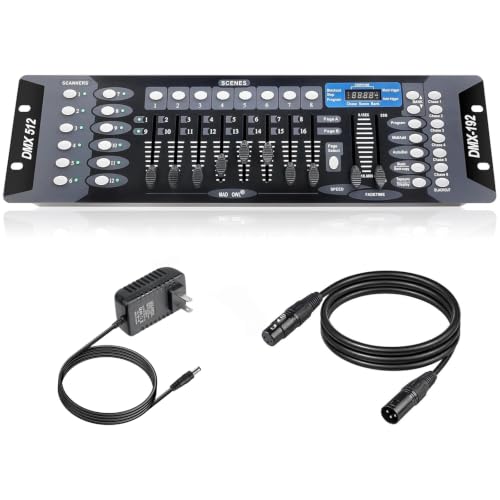
- Controls up to 12 fixtures
- Stores scenes and six chases
- Includes 6.6-foot DMX cable
Best For: DJs, clubs, stages, and performance venues
Compact Pro Control

- Supports up to four DMX universes
- Has four output sockets
- Includes 37 backlit buttons
Best For: Portable multi-universe event lighting
DJ-Integrated Lighting Control

- Offers two DMX universes
- Works with Engine DJ devices
- Adds touch, pad, and encoder control
Best For: DJs and live performers using SoundSwitch workflows
Flexible Scene Builder

- 384 DMX channels for detailed control
- 30 banks of 8 programmable scenes
- Compact console with gooseneck light
Best For: DJs and venues programming repeatable live-lighting scenes
Rack-Ready Event Control
Rockville ROCKFORCE 192 DMX Controller
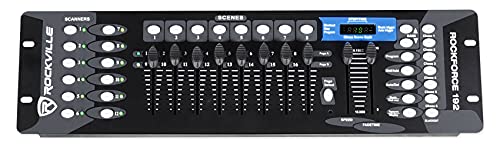
- 192 channels across 12 scanners
- Sound-activated effects via built-in microphone
- 23 scene banks and six programmable chases
Best For: DJs and event venues using physical controls and fog effects
Tablet-Based Show Control
ADJ MyDMX Go Wireless DMX Controller

- 256-channel tablet-based DMX control
- 15,000+ fixture library
- 50 presets and 21 automatic effects
Best For: Mobile operators seeking fast, app-based lighting setup
Versatile Scene Control

- Controls up to 12 fixtures
- Stores up to 240 scenes
- Includes voice control
Best For: DJs and event setups needing detailed multi-fixture control
Ready-Made Uplighting Kit

- Includes eight RGB par lights
- Offers several dynamic effects
- Provides wired and light-level controls
Best For: Portable party, wedding, and DJ uplighting
Wireless DMX Expansion
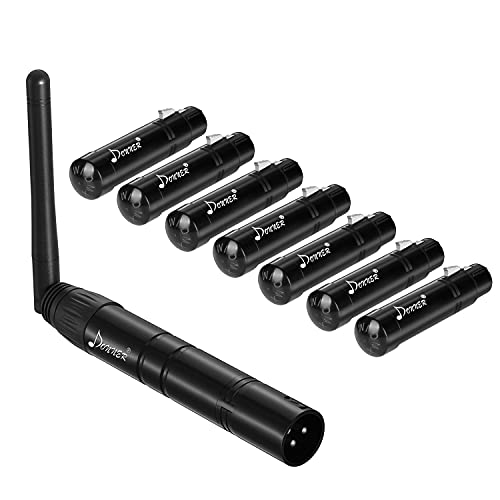
- Uses 2.4G wireless DMX transmission
- Provides seven selectable ID groups
- Requires external power adapters
Best For: Compatible DMX512 setups needing fewer signal cables
Flexible 192-Channel Pick – 192-Channel DMX Lighting Console
For shoppers comparing dmx controllers for events, this 192-channel console offers hands-on control for small to mid-sized stage, club, and DJ lighting setups. Its faders, programmable scenes, and chase functions provide a practical way to build and adjust shows in real time.
Best For: DJs, clubs, stages, and performance venues using up to 12 fixtures with 16 channels or fewer.
Pros:
- Controls up to 12 lighting fixtures with 192 total channels.
- Stores 23 banks of eight programmable scenes.
- Supports 240-step scenes across six programmable chases.
- Includes a 6.6-foot DMX cable and rack-mountable metal construction.
Cons:
- Its 192-channel design may be limiting for larger, more complex systems.
- The console is relatively large at 22.44 inches wide.
This is a straightforward choice when you want physical faders and extensive scene storage without moving to a computer-based lighting system. Check that your fixtures fit its 16-channel-per-unit limit.
Compact Pro Control – ADJ WMX1 Mk2 DMX Controller
The ADJ WMX1 Mk2 is a compact option for event operators who want dedicated controls in a portable standalone unit. It combines 37 backlit silicone buttons, four rotary encoders, and support for up to four DMX universes.
Best For: Event professionals and mobile operators who need multi-universe control in a compact standalone controller.
Pros:
- Supports up to four DMX universes.
- Provides four output sockets.
- Offers 37 backlit buttons for operation in dim environments.
- Uses four rotary encoders for hands-on adjustments.
Cons:
- The supplied notes do not specify scene-storage capacity or fixture limits.
- Its advanced multi-universe features may be more than needed for simple setups.
Choose this model when output capacity and a compact footprint matter more than a traditional bank-and-fader layout. Its 10-by-9.25-inch body and 2.36-pound weight should suit portable event rigs.
Accessible Event Console – MINGJIE 192-Channel DMX Controller
The MINGJIE 192-channel console is designed for events that need both automatic operation and programmable control. It supports sound-activated lighting, scene storage, and chase creation while keeping fixture selection, faders, timing, and functions clearly separated on the control surface.
Best For: Mobile DJs, parties, weddings, clubs, KTV bars, shows, and theatrical events using up to 12 intelligent fixtures.
Pros:
- Controls up to 12 intelligent fixtures through 192 DMX channels.
- Stores 240 scenes in 30 banks and supports six chases.
- Offers sound-activated mode for hands-free lighting changes.
- Includes a 4-foot, 3-pin DMX cable and supports 100–240V input.
Cons:
- The shorter included cable may not suit every venue layout.
- Its 192-channel capacity may not meet larger production requirements.
This model stands out for event users who want a conventional console with both music-responsive and programmed modes. Its alloy chassis, broad voltage support, and included cable make it a practical out-of-box option.
DJ-Integrated Lighting Control – SoundSwitch Control One
SoundSwitch Control One is a strong fit for event DJs who want lighting control integrated with music performance. It provides two DMX universes, tactile performance controls, and compatibility with selected Engine DJ and AlphaTheta workflows, while also supporting BPM detection from external audio sources.
Best For: DJs, live bands, and performers using SoundSwitch software or compatible Engine DJ and AlphaTheta systems.
Pros:
- Provides two DMX universe inputs and outputs with a thru option.
- Works directly with Engine DJ devices without a computer.
- Includes a touch strip, encoders, and customizable RGB performance pads.
- Can control color, brightness, strobe, moving heads, and gobos.
Cons:
- Some compatibility features require SoundSwitch software and, for PRO DJ LINK Bridge, a laptop.
- It offers two universes rather than the four listed for the ADJ WMX1 Mk2.
- Its feature set is most useful within supported DJ and software ecosystems.
This controller is best viewed as a performance-focused interface rather than a traditional standalone scene board. It is particularly compelling when live music synchronization and on-the-fly lighting effects are central to the event.
Flexible Scene Builder – 384-Channel DMX Controller
For events that need repeatable scenes and detailed fixture control, this 384-channel console gives you substantial programming capacity in a compact format. It supports DMX512 control, 24 fixtures, and 30 banks of eight scenes for building customized lighting shows.
Best For: DJs, bars, clubs, and live-event operators who want hands-on scene programming.
Pros:
- Provides 384 DMX channels for detailed lighting control.
- Offers 30 banks with eight programmable scenes each.
- Compact, lightweight design includes side handles and an LED gooseneck light.
- Supports 110–240Vac, 50–60Hz power input and DMX512 signaling.
Cons:
- Its scene-based workflow may require more preparation than app-driven systems.
- The supplied specifications do not mention built-in sound activation or wireless control.
This is a strong choice among DMX controllers for events when you prioritize channel capacity and programmed scenes over automated or tablet-based operation.
Rack-Ready Event Control – Rockville ROCKFORCE 192 DMX Controller
The Rockville ROCKFORCE 192 is a practical pick for events using conventional DMX lighting and fog equipment. Its 192 channels, physical sliders, programmable banks, and sound-activated operation support both manual adjustments and repeatable show sequences.
Best For: DJs, parties, concerts, and theatrical productions needing physical controls and fog-machine compatibility.
Pros:
- Controls 192 channels across 12 scanners with 16 channels each.
- Programs 23 banks of eight scenes and six chases of up to 240 scenes.
- Built-in microphone enables music-triggered lighting effects.
- Metal-and-plastic 3U rack-style unit includes eight manual sliders and power-failure memory.
Cons:
- Its 192-channel capacity is lower than some larger consoles.
- Physical rack-style controls are less portable than a tablet-based interface.
For buyers comparing DMX controllers for events, this model stands out when tactile sliders, sound activation, and compatibility with DMX-512 lighting and fog systems matter more than wireless app control.
Tablet-Based Show Control – ADJ MyDMX Go Wireless DMX Controller
ADJ’s MyDMX Go takes a software-first approach to event lighting, using an iPad or Android tablet for wireless control over Wi-Fi or USB. With a 256-channel interface, a large fixture library, presets, and automatic effects, it is designed to reduce manual programming.
Best For: Mobile event operators who want quick setup and tablet-based control across varied lighting fixtures.
Pros:
- Provides 256-channel DMX control through an iPad or Android tablet.
- Fixture library includes more than 15,000 fixtures for broad compatibility.
- Offers 50 user presets and 21 automatic effects without requiring traditional programming.
- Compact, lightweight interface supports two lighting universes and includes truss-mount O-Clamp brackets.
Cons:
- Requires a compatible tablet for the app-based control experience.
- Wireless operation is described through Wi-Fi; fixtures still connect through a 3-pin XLR input.
Among DMX controllers for events, the MyDMX Go is especially appealing when portability, fixture-library coverage, and fast preset-based operation are more important than dedicated console sliders.
Versatile Scene Control – CO-Z 192 DMX 512 Controller
For shoppers comparing dmx controllers for events, the CO-Z 192 DMX 512 Stage Light Controller offers broad fixture and scene control in a console designed for practical operation. It can manage up to 12 intelligent lights with up to 16 channels each, plus as many as 240 scenes.
Best For: DJs, weddings, church gatherings, nightclubs, and users who need detailed control of multiple lighting fixtures.
Pros:
- Controls up to 12 fixtures and 240 scenes.
- Supports up to 192 channel groups for complex shows.
- Includes voice control and dedicated selection, speed, and time controls.
- Works with compatible three-pin fixtures, including fog machines and par lights.
Cons:
- Its many controls may take time for first-time users to learn.
- It is a corded console rather than a wireless controller.
With its large channel capacity, scene storage, and upgraded control buttons, this is a practical choice when an event setup calls for hands-on, centralized lighting control.
Ready-Made Uplighting Kit – CO-Z 8-Pack RGB Par Lights
For dmx controllers for events that need lights included, this CO-Z set combines a DMX controller with eight compact RGB LED par lights. The kit supports up to 12 par lights, with up to eight channels assigned to each, and offers color-changing, flashing, fading, pulsing, and voice-control modes.
Best For: Weddings, parties, DJ sets, festivals, stage performances, and portable uplighting setups.
Pros:
- Includes eight RGB LED par lights and a controller.
- Supports multiple effects, including color changing, flashing, fading, and pulsing.
- Allows controller-based operation or basic adjustment from each light.
- Compact, lightweight lights are convenient to transport.
Cons:
- The included lights use plastic construction.
- Each par light provides up to eight channels, which may limit more advanced fixture programming.
This kit is a convenient starting point for colorful event lighting because the controller and lights are packaged together, reducing the need to match separate components.
Wireless DMX Expansion – Donner 2.4G Wireless DMX Set
For event productions where cabling is inconvenient, the Donner 2.4G wireless DMX set adds wireless signal transmission to compatible DMX512 equipment. Its transmitter and receivers use the 2.4G ISM band, support seven selectable ID groups, and transmit standard DMX512 data in real time.
Best For: Stage, disco, party, bar, and event lighting setups using compatible DMX512 devices where wireless connections are useful.
Pros:
- Wireless transmission avoids a direct signal cable between compatible devices.
- Offers seven selectable wireless network groups.
- Uses automatic frequency hopping across 126 channels for interference resistance.
- Transmits standard DMX512 protocol data in real time.
Cons:
- It supports only devices marked as DMX512-compatible.
- The units do not have a built-in battery and require a power adapter when operating.
- The supplied details list one transmitter and three receivers, despite the product title referencing seven receivers.
This set is best viewed as a wireless DMX link for compatible equipment rather than a complete lighting console, making it useful when reducing cable runs is a priority.
How We Picked the Best Dmx Controllers for Events
We focused on practical features that affect real event setups: DMX channel capacity, fixture and scene control, programming flexibility, portability, connection options, and ease of operation. The lineup includes traditional 192-channel boards, higher-capacity consoles, dedicated hardware, wireless systems, and software-oriented controllers.
We also considered how each option fits different users. A mobile DJ may value quick setup and compact controls, while a venue or production company may need more banks, fixtures, presets, and repeatable show programming.
Quick Comparison
| Controller Type | Best For | What to Look For |
|---|---|---|
| 192-channel console | Basic DJ and small-stage lighting | Faders, scenes, chases, and simple fixture access |
| 384-channel controller | Larger or more complex rigs | More fixture capacity, banks, scenes, and editing options |
| Standalone advanced controller | Repeatable professional shows | Programming depth, presets, and reliable hardware control |
| Wireless DMX system | Fast, cable-free installations | Transmission range, receiver count, and compatibility |
| App or software controller | Flexible modern workflows | Device compatibility, interface quality, and backup planning |
Key Buying Factors for Dmx Controllers for Events
Channel and Fixture Capacity
Choose a controller with enough channels for your current fixtures and reasonable expansion. Remember that each fixture may use several channels, so a higher channel count does not automatically equal a specific number of lights.
Programming and Live Operation
Look for accessible faders, scene buttons, banks, chases, and blackout controls if you need to make changes during a performance. For recurring productions, deeper editing and preset storage can save substantial setup time.
Compatibility and Connectivity
Confirm that the controller supports standard DMX512 connections and has the appropriate outputs, cables, adapters, or wireless receivers for your fixtures. Check channel modes carefully, since different fixtures may require different numbers of channels.
Portability and Reliability
Mobile operators should consider weight, rack compatibility, power requirements, and how easily the controller can be packed. Wireless systems reduce cable runs but add batteries, pairing, and signal-management considerations.
Ease of Use
A feature-rich controller is not useful if it slows down programming. Beginners may prefer straightforward consoles, while experienced operators can benefit from software control, advanced fixtures, and more detailed show editing.
Who Should Buy Which Dmx Controllers for Events?
Mobile DJs and Small Event Operators
A compact 192-channel console or an all-in-one lighting kit is usually the simplest starting point. Prioritize quick scene selection, built-in controls, and easy transport.
Clubs, Bars, and Small Venues
Choose a controller with enough fixture capacity for permanent installations and dependable access to chases, color changes, dimming, and blackout functions. Rack-mountable hardware can help keep the setup organized.
Professional Event and Stage Crews
Advanced standalone controllers or higher-capacity systems are better suited to repeatable productions with multiple fixture types and programmed scenes. Look for strong storage, editing, and expansion capabilities.
Installations That Need Minimal Cabling
Wireless DMX controllers and receiver systems can simplify temporary layouts and reduce trip hazards. Verify range, line-of-sight expectations, receiver compatibility, and backup procedures before relying on wireless control for a major event.